Consulting
- general consulting
- naval architecture
- structural eng.
- going on / off location
- SYSTEMS DESIGN
- Jack-up Units
- Semisubmersibles
- Barges
- operating manuals
- offshore animation
- custom software
ON SEMISUBMERSIBLES
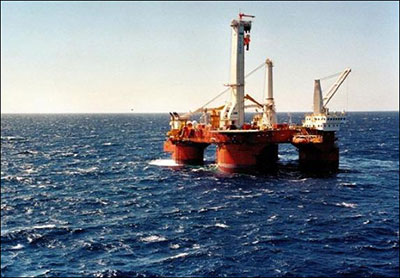
Bennett Offshore has performed a wide range of design and consulting services for our clients’ floaters, including the Q4000 semisubmersible.
For the Q4000, Bennett was selected for the basic design development of the unit and was later chosen for the detail design package. The scope of work included general arrangement drawings, global structural and fatigue analyses, redundancy analysis, all naval architecture including the stability analysis and loading conditions, marine operating manual, structural detail drawings, outfitting drawings, mechanical/piping drawings, heating and ventilation as well as quarters outfitting. Bennett Engineers were also responsible for updating all the basic design plans, excluding general arrangements, as the final configuration was developed to satisfy ABS, USCG and the customers' requirements. Post-construction, Bennett coordinated the inclining experiment and participated in the final sea trials.
We also have developed a few of our own designs. The Bennett team has drawn upon our years of experience with floating units to develop several innovative Offshore design solutions for a variety of operational uses. The BASS T-7 and Q-7 are 3-column and 4-column hulls,
respectively. These multi-purpose, scalable hull systems provide a wide
range of uses, including LNG terminals, deepwater production platforms and
even moored fendering applications, as we have done with our patented Softberth™ LNG Terminal System
Cal Dive International ordered the Q4000 in 1999, and Keppel AmFELS built it in Brownsville, Texas, for about $180 million. It entered service in 2002 under the US flag and was later operated by Helix Energy Solutions Group. The original concept belongs to SPD/McClure; Bennett developed the basic and detailed design described above.
In 2010 the vessel worked on the Deepwater Horizon response in the Gulf of Mexico. Crews used it to place the containment dome and for the unsuccessful "top kill", and later for the static kill. On 4 September 2010 the failed blowout preventer was recovered onto its deck as evidence.
Source: Wikipedia articles "Q4000" and "Bennett Offshore".